Table of Contents
For candidates preparing for the Certified Information Systems Security Professional (CISSP) credential, the exam itself represents as much of a mental challenge as the technical content. English-language CISSP exams administered by ISC2 utilize Computerized Adaptive Testing (CAT).
Unlike linear exams with a fixed set of questions, a CAT exam dynamically evaluates your competency in real time. The testing engine re-estimates your ability after every single answer, selecting the next question to be either harder or easier depending on your previous performance.
Understanding the underlying mechanics of the CAT algorithm and avoiding common “fix-it-first” technical traps is essential for passing the CISSP exam on your first attempt.
How the CISSP CAT Engine Evaluates Your Score
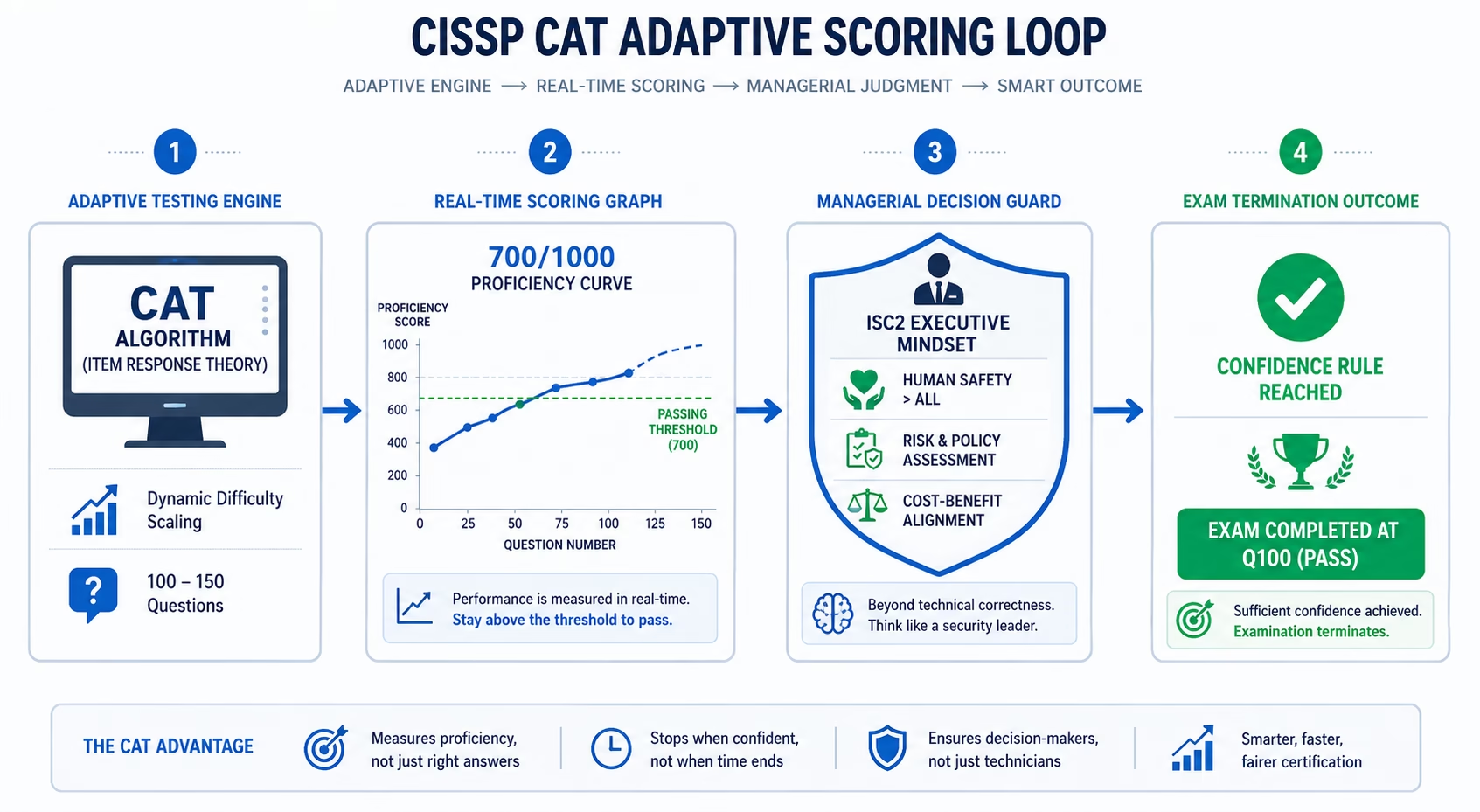
The CISSP CAT exam consists of 100 to 150 questions administered over a 3-hour time limit. Out of these, 25 items are unscored operational pretest items used by ISC2 to evaluate future questions.
Candidate Ability Scale (700 / 1000 Passing Threshold)
  1000 |------------------------------------------------------------
       |                   /---\  (Consistently Above Threshold)
   700 |==================/=====\==================================== PASS
       |                 /       \---\
     0 |------------------------------------------------------------
       Q1               Q50          Q100                     Q150
1. Item Response Theory (IRT)
The testing engine relies on Item Response Theory. Every question in the ISC2 item bank is assigned a difficulty rating and domain mapping.
- When you answer a question correctly, the engine selects a slightly more difficult question in the next iteration.
- When you answer a question incorrectly, the engine presents a simpler question or tests a different domain topic to re-evaluate your competency.
2. Passing & Stopping Criteria
The CAT algorithm terminates the exam under three specific conditions:
- 70% Confidence Rule (Early Pass): Once you answer at least 100 questions, if the algorithm determines with 95% statistical confidence that your ability score is above the passing standard (700 out of 1000 points) across all 8 domains, the exam ends immediately with a pass result.
- Early Fail Rule: If after 100 questions the algorithm determines with 95% confidence that you cannot reach the passing threshold within the remaining questions, the exam terminates early with a fail result.
- Maximum Length Rule: If confidence is not reached by question 149, the exam ends at question 150. The final evaluation determines whether your final ability estimate meets the passing standard.
Note: You cannot return to previous questions or review past answers on a CAT exam because each answer permanently changes the trajectory of the remaining test.
3 Fatal “Decision Traps” Technical Candidates Fall Into
The majority of candidates who fail the CISSP exam do not fail because they lack technical knowledge; they fail because they respond as technical engineers rather than security managers.
Trap 1: The “Fix the Technical Problem” Trap
When presented with a scenario involving a security breach or system failure, technical professionals immediately want to reconfigure a firewall, block an IP, or patch a server.
- Exam Reality: On the CISSP, technical fixes are rarely the immediate right answer. ISC2 tests management principles.
- Correct Mindset: Always look for steps involving assessment, policy evaluation, business impact analysis (BIA), and executive escalation before taking operational action.
Trap 2: Assuming You Have Unlimited Budget and Resources
Engineering mindsets often select the most comprehensive, highly redundant technical control available in the answer choices.
- Exam Reality: CISSP Domain 1 (Security and Risk Management) emphasizes cost-benefit analysis and business alignment.
- Correct Mindset: The right control must be cost-effective and aligned with organizational risk tolerance. A $100,000 security control implemented to protect a $10,000 asset is an incorrect choice.
Trap 3: Panic Caused by High-Difficulty Questions
Because the CAT algorithm raises question difficulty when you are performing well, candidates who are passing often feel like they are failing. Questions will feel ambiguous, complex, and unfamiliar.
- Exam Reality: Difficult, scenario-heavy questions are a strong indicator that the engine is testing you above the 700-point passing threshold.
- Correct Mindset: Expect ambiguity. Treat every question as an isolated scenario, evaluate all 4 options, and select the answer that best preserves business continuity and human safety.
4-Step CAT Exam Day Execution Strategy
- Prioritize Human Safety Above All Else: In any scenario involving physical security or emergency response, the protection of human life strictly overrides data confidentiality, integrity, or system availability.
- Pace Yourself for 150 Questions: Allocate approximately 1.2 minutes per question. Do not spend 5 minutes agonizing over a single item; make the most logical choice based on management principles and move forward.
- Read the Last Sentence First: CISSP questions often include lengthy scenario descriptions. Read the final sentence first to identify the core question (e.g., “What should the security manager do FIRST?”) before reading the full context.
- Identify the Domain Context: Determine which of the 8 CISSP domains the question targets (e.g., Domain 1 Risk Governance vs. Domain 3 Security Architecture) to filter out distractor choices.
Key Takeaways
- The CISSP CAT exam continuously adjusts question difficulty to measure your competence against a 700/1000 passing threshold across all 8 domains.
- You cannot review or change previous answers; every response permanently shapes the remaining exam path.
- Adopt a senior management perspective: prioritize human safety, policy alignment, business continuity, and risk assessment over immediate technical troubleshooting.