Table of Contents
For candidates preparing for the Certified Information Systems Auditor (CISA) certification, Domain 1: Information System Auditing Process forms the foundation of the entire exam. Covering 18% of the scored questions on the ISACA CISA Exam Content Outline, Domain 1 establishes the standards, methodologies, and evidence-gathering techniques that govern how an auditor evaluates IT controls.
A common pitfall for candidates from engineering or technical security backgrounds is answering questions as a system administrator or security implementer. On the CISA exam, ISACA evaluates your judgment as an independent auditor.
This guide breaks down the core audit lifecycle, the hierarchy of evidence reliability, compliance versus substantive testing, and the critical “first step” decision traps you will encounter on test day.
1. The Risk-Based Audit Planning Lifecycle
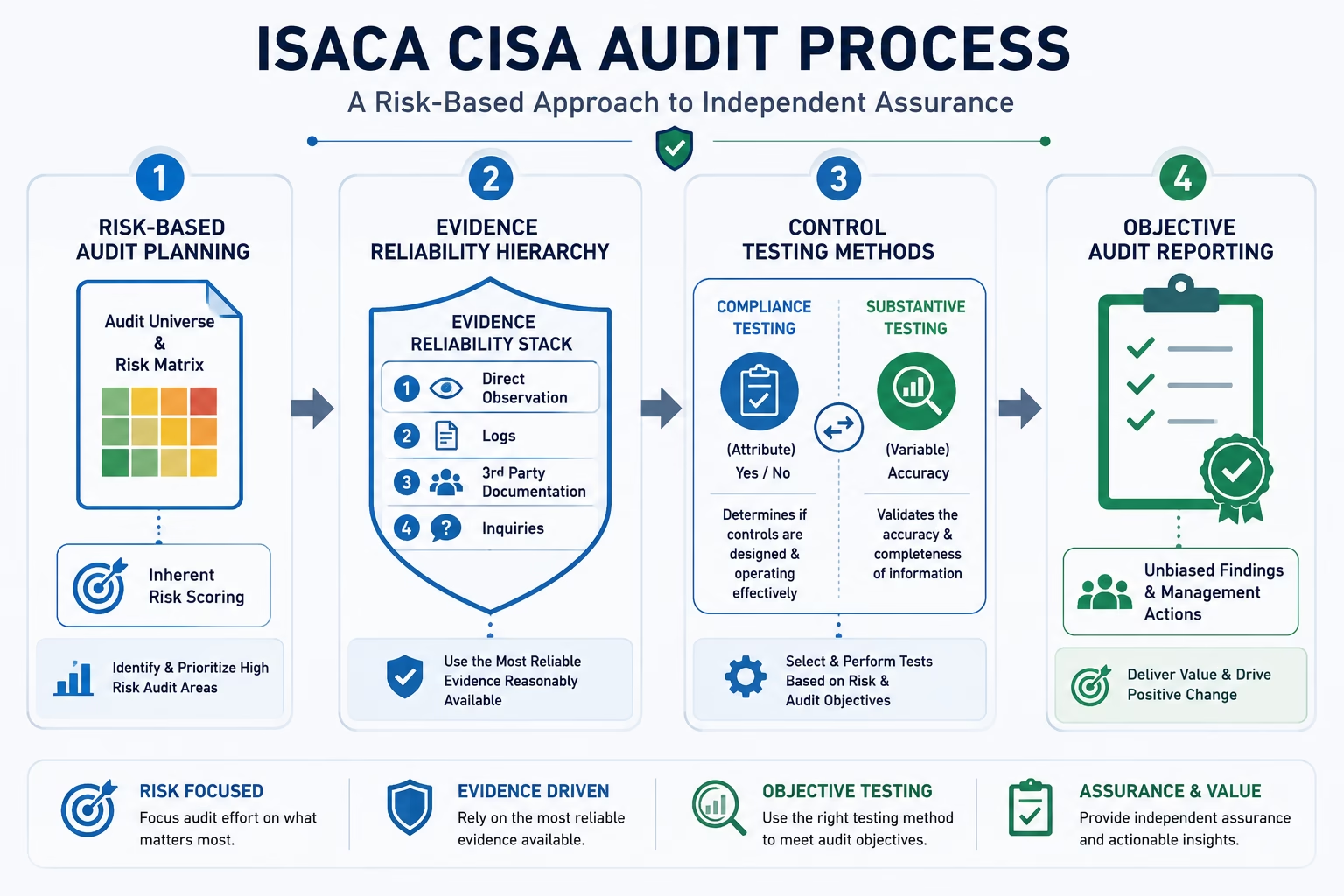
ISACA standards mandate a risk-based audit approach. Rather than attempting to audit every server or application equally, an IS auditor allocates finite audit resources based on the inherent risk and business impact of each system.
Audit Universe ➔ Inherent Risk Assessment ➔ Annual Audit Plan ➔ Engagement Scope ➔ Control Testing ➔ Reporting
- Define the Audit Universe: Identify all auditable entities, business processes, and IT assets across the enterprise.
- Conduct Risk Assessment: Evaluate inherent risk (likelihood and impact of failure) to prioritize auditable entities.
- Establish Engagement Scope & Objectives: Define the boundaries, timeframes, and specific control frameworks (e.g., COBIT, NIST CSF, ISO 27001) for the audit engagement.
- Execute Fieldwork & Testing: Gather evidence through inquiry, observation, inspection, and automated re-performance.
- Report & Follow-Up: Deliver findings to executive management and conduct follow-up testing to verify remediation.
2. Audit Evidence Reliability Hierarchy
On the CISA exam, questions frequently present multiple sources of audit evidence and ask you to select the MOST reliable option. Evidence reliability follows a strict hierarchy based on independence and objectivity.
| Evidence Type | Reliability Level | Key Characteristics & Examples | ISACA Exam Rule |
|---|---|---|---|
| Direct Auditor Observation / Re-performance | Highest (Rank 1) | The auditor directly witnesses a process or runs an independent test script (e.g., observing physical badge entry). | Always preferred over indirect statements or second-hand summaries. |
| System-Generated Logs & Automated Reports | High (Rank 2) | Automated, write-once SIEM logs, database audit trails, or cryptographic access records generated without human intervention. | Highly objective; must confirm the logging mechanism itself is secure from tampering. |
| Third-Party Independent Evidence | Moderate to High (Rank 3) | SOC 2 Type II reports, external bank confirmations, or independent penetration test reports. | More reliable than internal documents because the provider is outside the audited organization. |
| Internal Written Documentation & Policies | Moderate (Rank 4) | System architecture diagrams, configuration runbooks, approved change tickets. | Confirms policy exists, but does not prove operational effectiveness on its own. |
| Inquiry & Oral Statements | Lowest (Rank 5) | Verbal interviews with system administrators, developers, or business owners. | Never sufficient as standalone audit evidence; must always be corroborated by testing. |
3. Compliance Testing vs. Substantive Testing
Understanding the distinction between compliance and substantive testing is essential for answering audit methodology questions.
- Compliance Testing (Testing of Controls): Determines whether an internal control exists and operates effectively as designed.
- Example: Testing whether all password changes enforce complexity rules, or verifying that user access terminations have management sign-off.
- Substantive Testing (Testing of Data Integrity & Transactions): Evaluates the actual financial, transaction, or data values directly for material misstatements or errors.
- Example: Performing database recalculations of interest accrued on loan accounts, or verifying physical server inventory against asset balance sheets.
The Relationship: If compliance testing reveals that controls are strong, the auditor can reduce the extent of substantive testing. If compliance testing shows that controls are weak or missing, the auditor must expand substantive testing to quantify the actual impact.
4. Audit Sampling Methods: Attribute vs. Variable
| Sampling Method | Testing Type | Primary Question Answered | Practical IT Audit Example |
|---|---|---|---|
| Attribute Sampling | Compliance Testing | “Does the control work or not?” (Yes/No rate of occurrence) | Sampling 50 employee onboarding tickets to verify what percentage have background check sign-offs. |
| Variable Sampling | Substantive Testing | “How much is the monetary or numeric error?” (Continuous values) | Sampling ledger records to calculate the total monetary discrepancy in cloud computing billing statements. |
| Stratified Sampling | Both | “Are high-value assets adequately tested?” | Grouping user accounts into privileged admins vs. regular users and testing 100% of the admin accounts. |
5. 3 Common ISACA “Exam Traps” in Domain 1
Trap 1: The “Fix the Problem” Trap
When an auditor discovers a missing control (e.g., unpatched critical vulnerability or disabled audit logs), technical professionals often choose an answer like “Configure the log forwarding immediately” or “Apply the patch.”
- The Exam Reality: An IS auditor NEVER fixes systems or implements operational changes. Doing so violates auditor independence.
- The Correct Action: Quantify the risk, assess the impact on audit objectives, and report the finding with a management recommendation.
Trap 2: The “Report to Executive Management / Police FIRST” Trap
When an anomaly or non-compliance is spotted, distractor answers often suggest immediately alerting the Board of Directors, the audit committee, or external regulators.
- The Exam Reality: Before escalating, the auditor must first conduct sufficient testing to substantiate the finding and understand the root cause.
- The Correct Action: Verify the facts, evaluate the compensating controls, and discuss the preliminary observation with the process owner.
Trap 3: The “Sample Size” Assumption
Candidates often believe that larger sample sizes automatically make an audit report valid.
- The Exam Reality: Statistical sampling requires random selection and measurable confidence intervals; a non-statistical sample of 500 items can still introduce selection bias.
- The Correct Action: Choose statistical sampling methods when measurable error rates and defensible confidence levels are required.
Key Takeaways
- CISA Domain 1 tests your judgment as an independent assurance professional, not an IT implementer.
- Direct auditor observation and system-generated logs represent the highest standard of evidence reliability; oral statements represent the lowest.
- Compliance testing evaluates control design and operation; substantive testing evaluates data accuracy and transaction integrity.
- When non-compliance is discovered, an auditor evaluates the impact and verifies the facts before escalating findings.