
Table of Contents
Centralized management consoles serve as the nerve center for enterprise network security. When a management plane is compromised, threat actors gain full visibility into firewall configurations, routing tables, and access control policies across the entire corporate infrastructure.
The Cybersecurity and Infrastructure Security Agency (CISA KEV Catalog) added an actively exploited vulnerability in Cisco Secure Firewall Management Center (FMC)—tracked as CVE-2026-20316—to its Known Exploited Vulnerabilities catalog. The flaw stems from static, hardcoded credentials (CWE-259) in the software’s web interface, allowing unauthenticated remote attackers to log into exposed management consoles.
For security operations teams and infrastructure architects, this zero-day incident highlights a recurring systemic risk: the exposure of Tier-0 management planes to untrusted networks and the danger of static credentials in administrative software.
Technical Breakdown of CVE-2026-20316
Cisco Secure Firewall Management Center (formerly Firepower Management Center) centralizes firewall administration, event logging, and policy enforcement across enterprise networks.
Attack Vector & Execution Mechanism
- Vulnerability Type: Static User Credentials (CWE-259).
- Impact: An unauthenticated network attacker can log into the FMC web interface with low-privilege access without interacting with a legitimate user.
- CVSS Score: 5.3 Medium (CVSS:3.1/AV:N/AC:L/PR:N/UI:N/S:U/C:L/I:N/A:N).
- Operational Risk: While the base CVSS score reflects limited direct confidentiality loss, initial access to a management console provides attackers with internal diagnostic data, license configurations, and an ideal launchpad for privilege escalation or lateral movement.
Because the attack leverages valid credentials, standard signature-based Network Intrusion Detection Systems (NIDS) fail to flag the initial login as malicious. Detection relies on web server log analysis and behavioral anomaly detection.
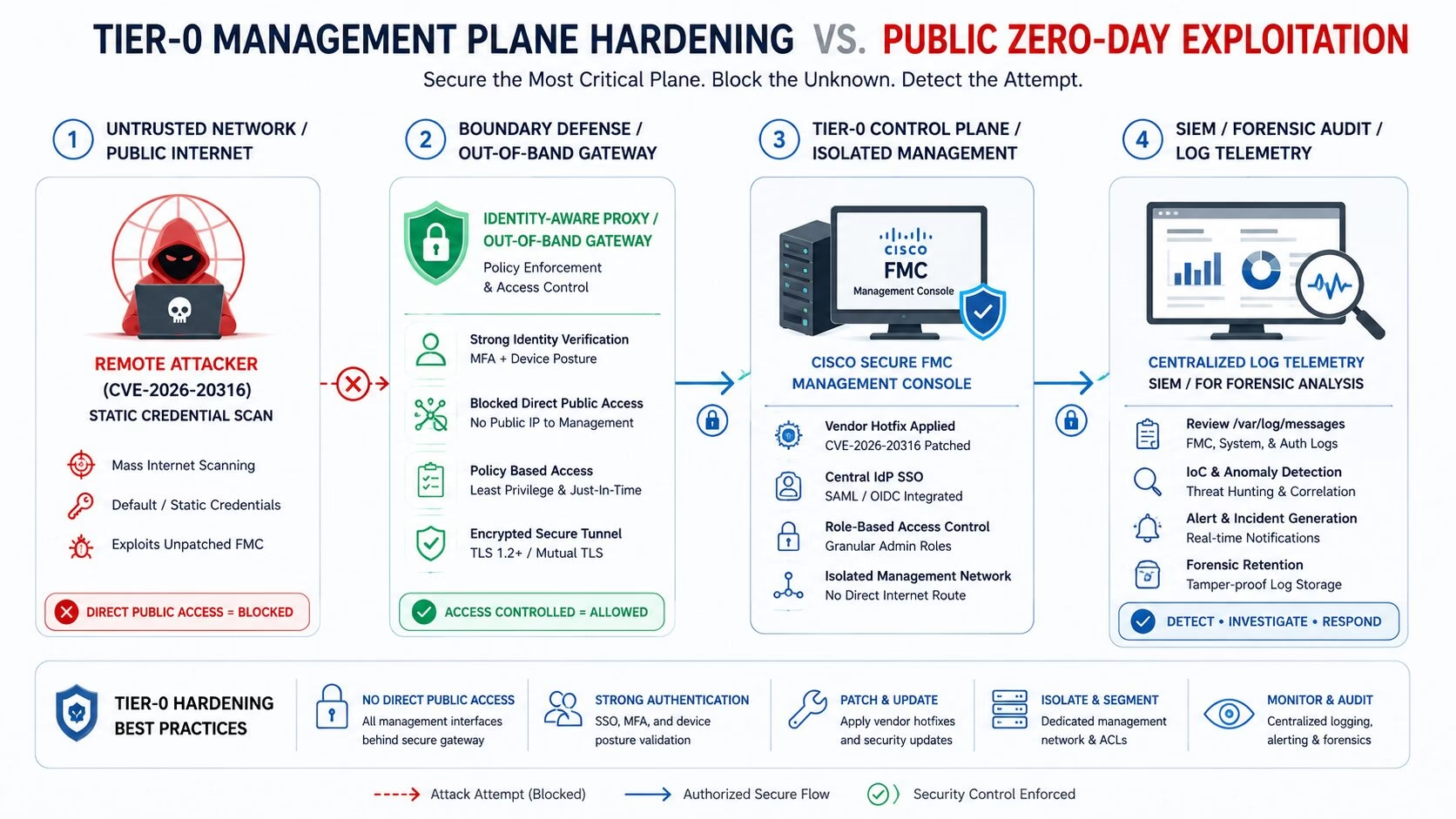
4 Architectural Principles for Securing Tier-0 Management Planes
The active exploitation of CVE-2026-20316 underscores why tier-0 management assets must be isolated behind strict architectural boundaries.
1. Eliminate Direct Public Internet Reachability
No management interface—whether for firewalls, hypervisors, SIEM consoles, or Identity Providers—should ever be exposed directly to the public internet. Access must require an out-of-band management network, an Identity-Aware Proxy (IAP), or a Bastion host with phishing-resistant Multi-Factor Authentication (MFA).
2. Disable Hardcoded & Local Fallback Accounts
Audit all enterprise management appliances for hardcoded, default, or unmonitored local service accounts. Ensure all administrative authentications route through a centralized Identity Provider (IdP) enforcing Single Sign-On (SSO) and continuous risk scoring.
3. Enforce Microsegmentation for Control Planes
Isolate management traffic onto a dedicated, encrypted Out-of-Band (OOB) VLAN. Enforce strict firewall rules so that management ports (such as HTTPS 443 or SSH 22) only accept inbound connections from designated, posture-checked administrative subnets.
4. Continuous Forensic Log Audit
Audit management console web server access logs for anomalous source IP addresses and unusual post-login commands. In Cisco FMC environments, security teams should inspect expert mode logs (/var/log/messages) for unexpected service execution or temporary directory invocations (/var/tmp/).
Remediation & Emergency Response Checklist
Organizations operating affected Cisco Secure FMC release trains (7.0, 7.2, 7.4, 7.6, 7.7, and 10.0) should execute the following emergency response steps immediately:
- Apply Official Vendor Hotfixes: Install specific Cisco release hotfixes across all physical and virtual FMC consoles.
- Restrict Interface Exposure: Verify that HTTPS management interfaces are blocked from public internet routing.
- Conduct Post-Exploitation Log Audits: Review web access and audit logs for logins from unknown external IP ranges occurring prior to hotfix installation. Installing a patch closes the flaw but does not evict an active attacker who obtained access prior to patching.
Key Takeaways
- CVE-2026-20316 demonstrates that low-CVSS flaws in Tier-0 management planes carry severe operational risk when chained with administrative access.
- Management interfaces must be isolated on dedicated out-of-band networks and never exposed to public IP space.
- Effective vulnerability response requires applying vendor hotfixes while simultaneously conducting forensic log reviews to verify no prior compromise occurred.