Table of Contents
For security managers and candidates pursuing the Certified Information Security Manager (CISM) credential, Domain 2: Information Security Risk Management serves as the analytical core of enterprise security governance. Accounting for 20% of scored questions on the ISACA CISM Exam Content Outline, Domain 2 tests your ability to identify, assess, treat, and monitor risk through a business-aligned lens.
The primary reason technical practitioners struggle with CISM Domain 2 is approaching security as an engineering exercise aimed at eliminating all vulnerabilities. ISACA evaluates your competency as a strategic advisor: security exists to support business objectives, and managing risk is about optimizing business value within defined organizational tolerances.
This study guide breaks down the distinction between risk appetite and risk tolerance, quantitative risk calculation formulas, the four risk treatment options, and the most common decision traps on the CISM exam.
1. Governance Foundation: Appetite vs. Tolerance vs. Capacity
ISACA questions frequently test your ability to differentiate between how much risk an organization can take, how much it wants to take, and what variance it will accept during operations.
| Governance Term | Definition | Organizational Level | Practical Enterprise Example |
|---|---|---|---|
| Risk Capacity | The maximum amount of risk an enterprise can absorb before its survival is threatened. | Enterprise / Board Level | The organization has $50M in reserve capital; losing more than $50M results in insolvency. |
| Risk Appetite | The amount of risk an organization is willingly prepared to accept in pursuit of its business goals. | Executive Management / Board | Executive leadership accepts moderate cloud migration risks to accelerate product time-to-market. |
| Risk Tolerance | The acceptable variance from risk appetite under specific operational conditions. | Operational / Business Unit | A temporary downtime of up to 4 hours is tolerated during emergency system patching windows. |
2. Quantitative vs. Qualitative Risk Assessment
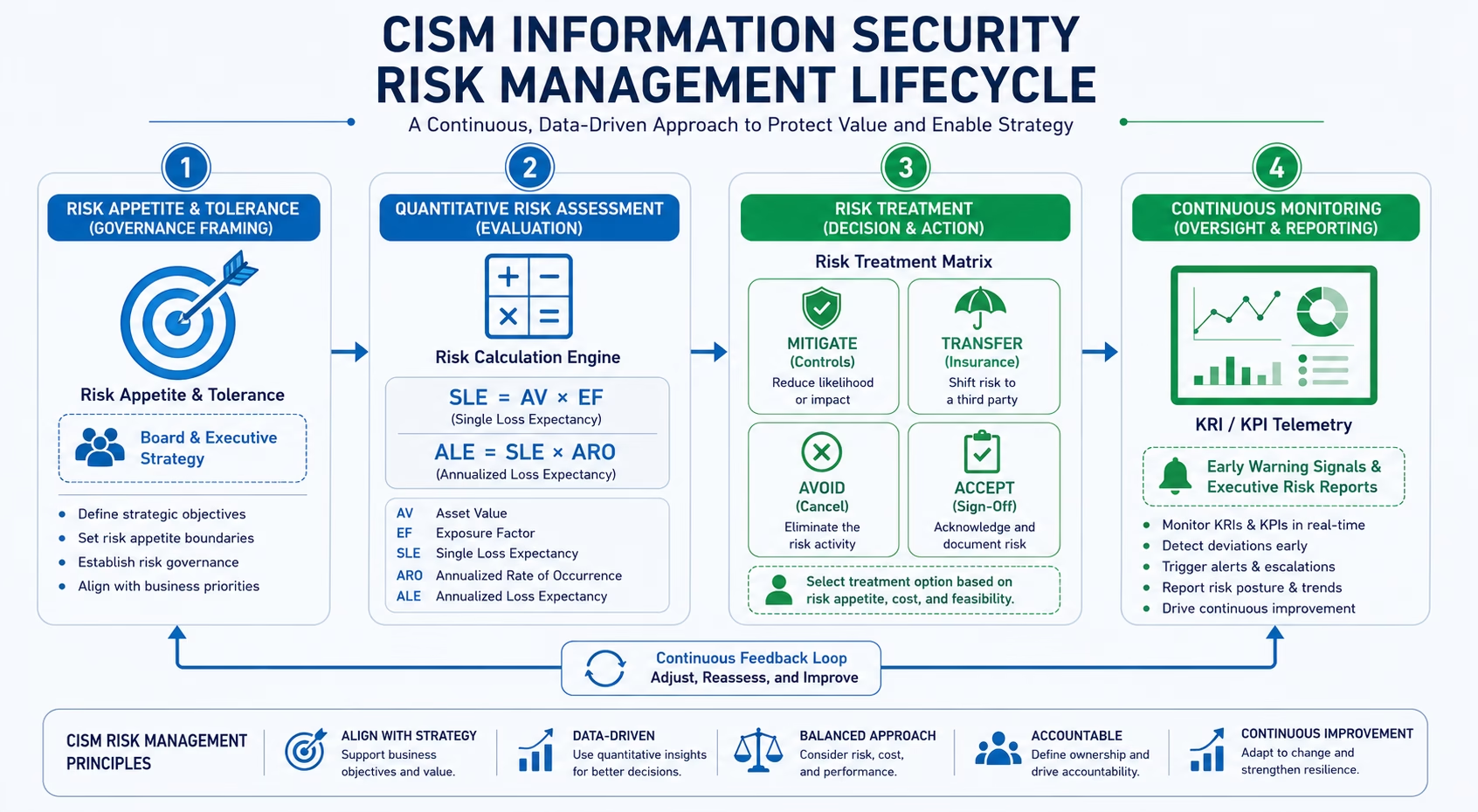
ISACA tests both qualitative (subjective ranking) and quantitative (financial modeling) risk methodologies. For quantitative scenarios, candidates must know how to calculate Single Loss Expectancy and Annualized Loss Expectancy.
The 4 Core Quantitative Formulas:
- Single Loss Expectancy (SLE): The monetary loss expected every time an incident occurs.$$\text{SLE} = \text{Asset Value (AV)} \times \text{Exposure Factor (EF)}$$(Example: If a database server is worth $200,000 and a flood damages 50% of it, $\text{SLE} = \$200,000 \times 0.50 = \$100,000$.)
- Annualized Loss Expectancy (ALE): The projected financial loss an enterprise expects over a one-year period.$$\text{ALE} = \text{Single Loss Expectancy (SLE)} \times \text{Annualized Rate of Occurrence (ARO)}$$(Example: If a $100,000 incident occurs once every 4 years ($\text{ARO} = 0.25$), $\text{ALE} = \$100,000 \times 0.25 = \$25,000$.)
- Annual Cost-Benefit Analysis (CBA): Determines whether implementing a security control is financially justified.$$\text{Cost-Benefit} = (\text{ALE}_{\text{before}} – \text{ALE}_{\text{after}}) – \text{Annual Cost of Control (ACS)}$$Rule: If the result is negative, the security control costs more than the risk it mitigates and should not be implemented.
3. The 4 Risk Treatment Options: When to Use Each
Once an assessment identifies residual risk exceeding risk appetite, executive leadership chooses one of four risk treatment pathways:
| Treatment Option | Core Action | When to Apply | Exam Scenario Example |
|---|---|---|---|
| Risk Mitigation (Reduction) | Implement security controls to lower likelihood or impact. | When cost-effective technical or administrative controls exist to bring risk within appetite. | Deploying multi-factor authentication (MFA) and EDR agents to mitigate credential theft. |
| Risk Transfer (Sharing) | Share or shift financial loss to a third party. | When internal remediation costs exceed the cost of insurance or specialized outsourced service SLAs. | Purchasing cyber insurance or entering into cloud hosting contracts with guaranteed financial SLAs. |
| Risk Avoidance | Completely eliminate the activity or asset causing the risk. | When risk exposure exceeds risk capacity and no control can mitigate it affordably. | Canceling a planned expansion into an unvetted foreign market with extreme regulatory penalties. |
| Risk Acceptance | Formally acknowledge residual risk without implementing additional controls. | When residual risk is within risk appetite, or when control costs exceed asset value. | Documenting executive sign-off to accept the risk of a legacy internal accounting tool. |
4. Key Risk Indicators (KRIs) vs. Key Performance Indicators (KPIs)
- Key Risk Indicators (KRIs):Forward-looking (leading) metrics that signal changes in risk exposure before an incident occurs.
- Example: Increase in unauthorized access attempts or rising numbers of unpatched critical CVEs.
- Key Performance Indicators (KPIs):Historical (lagging) metrics that measure how effectively a security process or control performed.
- Example: Mean Time to Detect (MTTD), Mean Time to Remediate (MTTR), or percentage of staff completing security awareness training.
5. 3 Common ISACA “Exam Traps” in Domain 2
Trap 1: “Who Owns the Risk?”
When an exam scenario asks who is accountable for accepting or treating a risk, choices often include the Information Security Manager, CISO, or IT Director.
- The Exam Reality: Security managers NEVER own business risk. The security manager analyzes risk, advises stakeholders, and designs controls.
- The Correct Action: Business Process Owners (Asset Owners) and executive leadership own the risk and make final acceptance decisions.
Trap 2: The “Zero Risk” Fallacy
Technical candidates often select answers aimed at reducing risk to zero.
- The Exam Reality: Zero risk does not exist in business operations. Eliminating all risk requires stopping business operations entirely (Risk Avoidance).
- The Correct Action: Select controls that reduce residual risk to an acceptable level within the organization’s stated risk appetite.
Trap 3: The “Technology First” Approach
When evaluating how to manage a newly discovered risk, candidates jump to buying software or deploying firewalls.
- The Exam Reality: Technology implementation without a formal Business Impact Analysis (BIA) and risk assessment violates governance standards.
- The Correct Action: First evaluate the asset value, quantify business impact, and determine organizational risk appetite before recommending controls.
Key Takeaways
- Risk appetite represents strategic risk tolerance set by the Board; risk tolerance is the acceptable operational variance.
- Single Loss Expectancy ($\text{SLE} = \text{AV} \times \text{EF}$) and Annualized Loss Expectancy ($\text{ALE} = \text{SLE} \times \text{ARO}$) provide the mathematical baseline for cost-benefit analysis.
- Business asset owners own the risk; security managers serve as trusted advisors who assess risk and measure control effectiveness.
- KRIs provide early warning signals of rising risk exposure; KPIs measure past operational performance.