
Table of Contents
Traditional castle-and-moat network security assumed that everything inside a corporate network perimeter was inherently trustworthy. Modern hybrid environments, remote workforces, and multi-cloud infrastructure have rendered this static perimeter model obsolete. Attackers who gain access through a single compromised credential or device can move laterally across enterprise subnets without friction.
Zero Trust Architecture (ZTA) removes implicit trust based on network location. Standardized by the National Institute of Standards and Technology in NIST SP 800-207, Zero Trust enforces explicit verification, least privilege access, and assumed breach conditions for every access request, regardless of whether it originates inside or outside the corporate network.
For security leaders and candidates preparing for the CISSP exam, understanding the core logical components, enforcement control planes, and migration pathways of Zero Trust is essential for building resilient security architecture.
Core Tenets of Zero Trust Security
Zero Trust is a strategic framework rather than a single vendor product. The architecture operates on three foundational principles:
- Verify Explicitly: Always authenticate and authorize based on all available data points, including user identity, location, device health, resource classification, and threat intelligence.
- Use Least Privilege Access: Limit user and service access with Just-In-Time (JIT) and Just-Enough-Access (JEA) policies, risk-based adaptive policies, and data protection controls.
- Assume Breach: Minimize blast radius by segmenting access by network, user, devices, and application awareness. Encrypt all sessions end-to-end and utilize analytics to gain visibility into anomalies.
Logical Architecture: PDP, PEP, and PIP
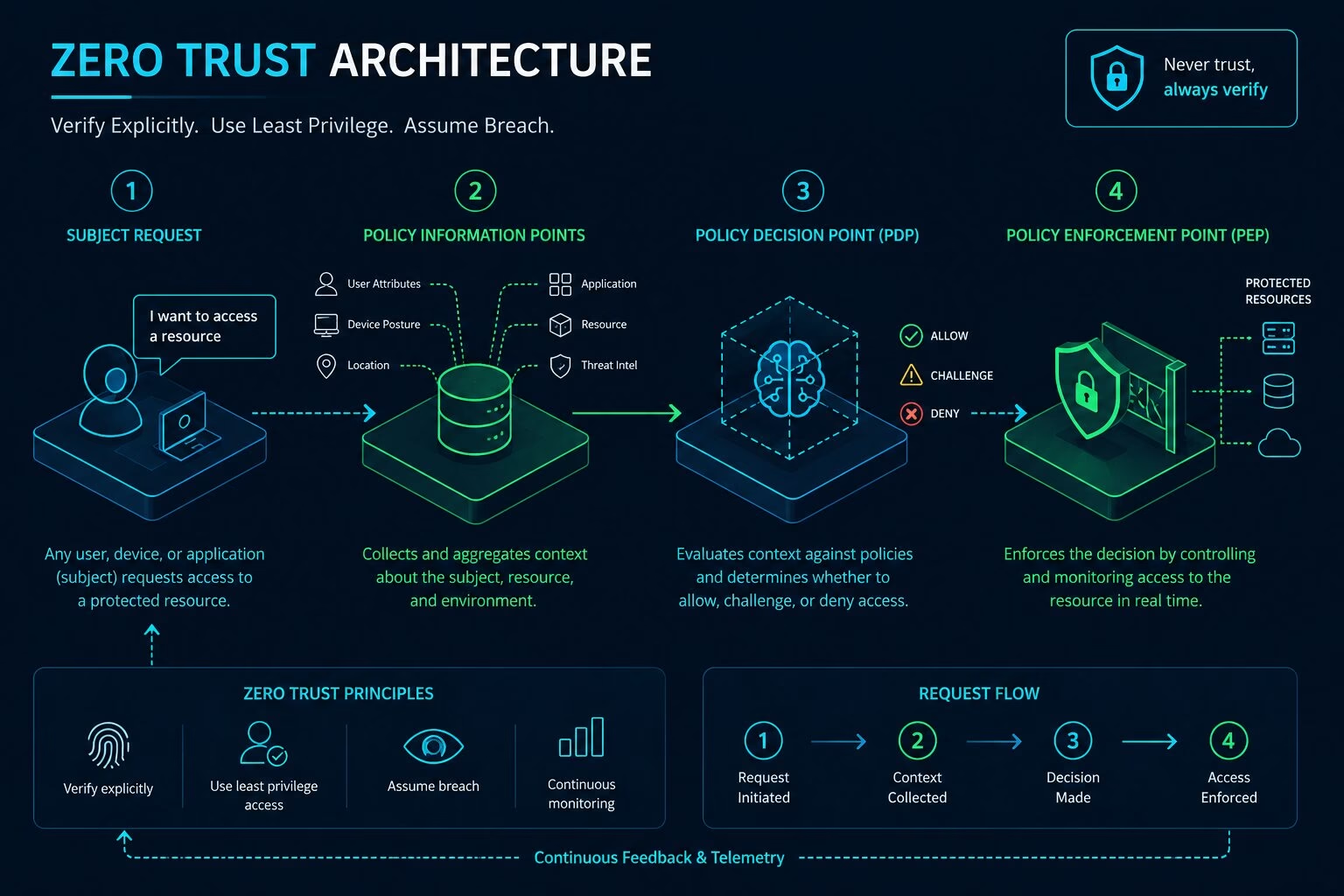
Per NIST SP 800-207, a Zero Trust deployment relies on three primary logical components split between the control plane and the data plane.
       +-------------------------------------------------------+
       |                  CONTROL PLANE                        |
       |  Policy Information Points (PIPs: IdP, EDR, SIEM)     |
       |                           |                           |
       |            Policy Decision Point (PDP)                |
       |      [ Policy Engine + Policy Administrator ]         |
       +---------------------------+---------------------------+
                                   |
                  Commands (Allow / Deny / Step-up)
                                   |
       +---------------------------v---------------------------+
       |                   DATA PLANE                          |
       |            Policy Enforcement Point (PEP)             |
       |      (Identity-Aware Proxy / Microsegment Gateway)    |
       |                           |                           |
       |         Subject ------> [ PEP ] ------> Resource      |
       +-------------------------------------------------------+
1. Policy Decision Point (PDP) — Control Plane
The Policy Decision Point renders the ultimate decision to grant, deny, or revoke access to a resource for a given subject (user, device, or service account). The PDP comprises two logical sub-components:
- Policy Engine (PE): Evaluates access requests against enterprise security policies and threat signals to compute a trust verdict.
- Policy Administrator (PA): Translates the Policy Engine’s decision into operational commands, signaling the Policy Enforcement Point to establish or terminate the session path.
2. Policy Enforcement Point (PEP) — Data Plane
The Policy Enforcement Point resides on the data path adjacent to protected resources. The PEP gates all incoming connections, inspecting credentials and enforcing the PDP’s decisions. Examples include Identity-Aware Proxies (IAP), cloud access security brokers (CASB), or local microsegmentation firewalls.
3. Policy Information Points (PIPs)
Policy Information Points supply real-time context to the PDP. These include Identity and Access Management (IAM) solutions, Endpoint Detection and Response (EDR) agents, Threat Intelligence feeds, and Security Information and Event Management (SIEM) telemetry.
CISSP Domain Mapping: Integrating Zero Trust into Practice
When implementing Zero Trust across an enterprise infrastructure, map requirements directly to core CISSP domain concepts:
| CISSP Domain | Zero Trust Control Mechanism | Practical Implementation |
| Domain 3: Security Architecture & Engineering | Control/Data Plane Separation | Deploying cloud-managed PDP control planes alongside lightweight edge PEPs close to applications. |
| Domain 5: Identity & Access Management (IAM) | Continuous Authentication & Short-lived Tokens | Replacing static IP whitelist rules with OAuth 2.0 / OIDC tokens and short-lived mTLS client certificates. |
| Domain 4: Communication & Network Security | Microsegmentation | Enforcing application-layer proxies and eBPF network security policies to eliminate lateral network movement. |
| Domain 7: Security Operations | Automated Response & Telemetry | Feeding continuous EDR and SIEM posture checks into the Policy Engine to dynamically revoke active sessions upon risk escalation. |
4-Step Practical Enterprise Implementation Roadmap
Migrating an enterprise from perimeter security to a mature Zero Trust posture requires an incremental, risk-prioritized methodology:
- Identify the Protect Surface: Define the high-value DAAS elements—Data, Applications, Assets, and Services—that require protection, rather than focusing on broad subnets.
- Map Transaction Flows: Trace how users, service accounts, and API calls interact with each protect surface under baseline conditions.
- Architect the Zero Trust Boundary: Place an explicit Policy Enforcement Point in front of the protect surface, decoupling access control from underlying network topologies.
- Enforce Dynamic Policy & Continuous Monitoring: Transition from static access control lists (ACLs) to risk-adaptive policies that evaluate identity, posture, and environmental signals per session.
Key Takeaways
- Network location no longer grants implicit trust; every access request must be explicitly authenticated and authorized.
- NIST SP 800-207 structures Zero Trust into a control plane (PDP) and a data plane (PEP) fed by continuous telemetry (PIPs).
- Implementing Zero Trust is an architectural evolution that prioritizes protecting high-value assets through identity governance, microsegmentation, and real-time risk assessment.
