
Table of Contents
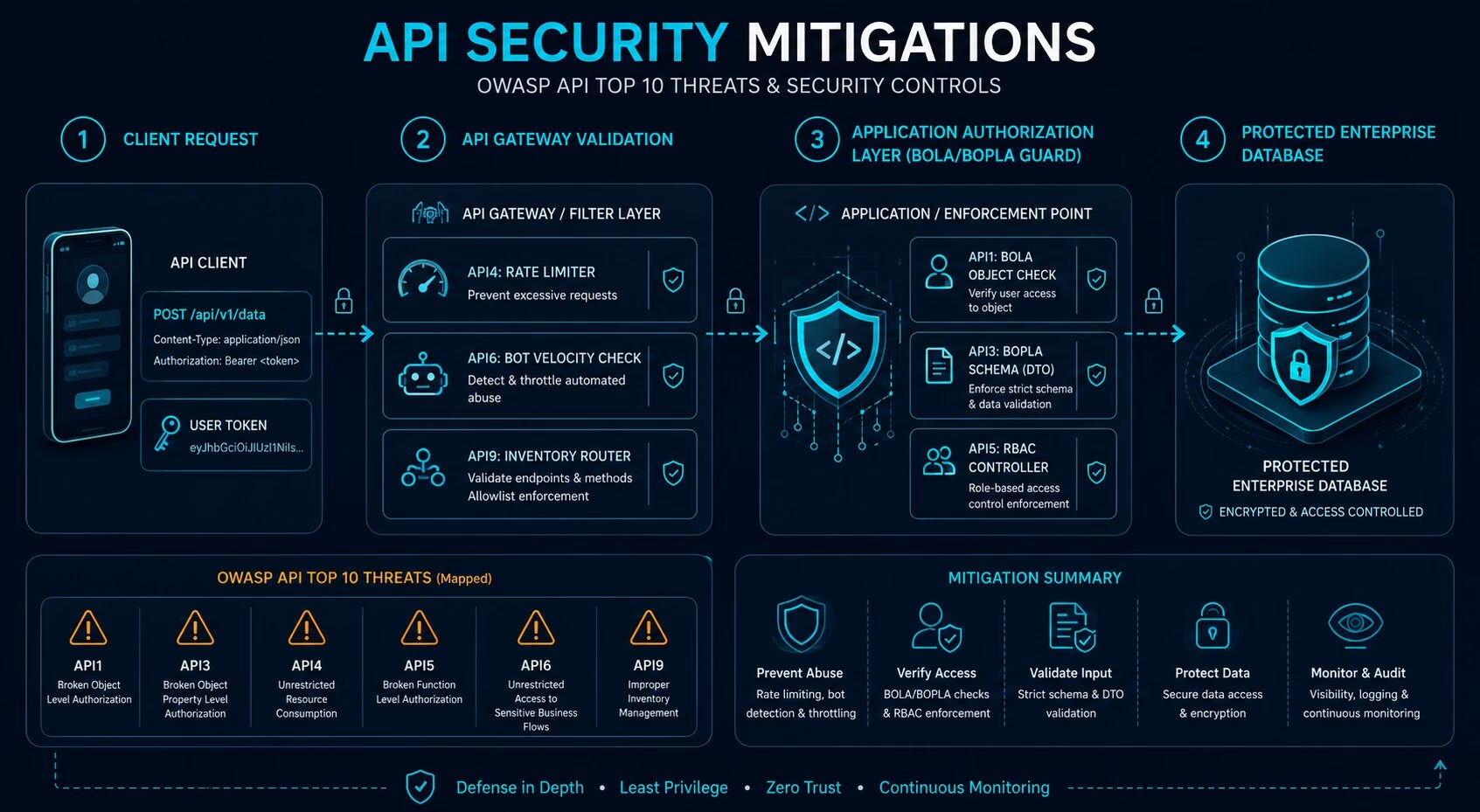
Application Programming Interfaces (APIs) form the core communication backend of modern software. Mobile apps, web frontends, microservices, and partner integrations rely on REST, GraphQL, and gRPC endpoints to transfer business data. While traditional web application firewalls (WAFs) inspect incoming HTTP payloads for cross-site scripting or basic SQL injection, they frequently fail to detect API-specific logical abuses.
Unlike traditional web applications that hide application logic behind server-side rendered HTML, APIs directly expose underlying data structures, object identifiers, and business workflows. To address these distinct architectural risks, the Open Worldwide Application Security Project maintains the OWASP API Security Top 10, establishing the industry baseline for API threat mitigation.
Understanding these vulnerabilities and implementing defense-in-depth at the API gateway and application layers is critical for security engineers and platform architects.
Authorization Failures: The Dominant API Threat Vector
Authorization logic flaws dominate the top entries of the OWASP API Security risks. Traditional perimeter firewalls cannot evaluate whether a logged-in user is authorized to read or modify a specific database record requested by an API call.
1. API1:2023 — Broken Object Level Authorization (BOLA)
BOLA remains the single most exploited API vulnerability in enterprise breaches. It occurs when an API endpoint exposes an object identifier (e.g., /api/v1/orders/1002) but fails to validate that the authenticated user owns or has explicit permission to access object 1002. Attackers iterate through numerical or UUID identifiers to harvest sensitive records at scale.
Defense: Implement strict access control checks at the code level for every endpoint that receives an object ID. Validate user authorization against the requested object ID before returning data.
2. API3:2023 — Broken Object Property Level Authorization (BOPLA)
BOPLA merges the previous concepts of Excessive Data Exposure and Mass Assignment. It occurs when endpoints expose sensitive internal object properties in JSON responses (relying on the frontend to filter them) or accept unvalidated JSON input properties that overwrite protected database fields (e.g., submitting “is_admin”: true in a profile update payload).
Defense: Define explicit Data Transfer Objects (DTOs). Schema-validate all incoming API payloads and restrict outgoing responses to only the fields necessary for the client.
3. API5:2023 — Broken Function Level Authorization (BFLA)
BFLA occurs when an API fails to enforce role-based access control (RBAC) on sensitive administrative endpoints. An attacker logged in as a standard user can invoke administrative endpoints (e.g., changing /api/v1/users/profile to DELETE /api/v1/admin/users/1002) if authorization checks are only performed on the user interface rather than at the controller layer.
Defense: Enforce centralized RBAC and Attribute-Based Access Control (ABAC) checks at the controller entry point for every administrative action.
Business Logic & Resource Abuse
Beyond authorization flaws, APIs are susceptible to automated resource exhaustion and business logic manipulation.
| OWASP Risk | Failure Mechanism | Remediation Strategy |
|---|---|---|
| API4:2023 Unrestricted Resource Consumption | Lacking rate limits, payload execution timeouts, or memory limits, allowing denial-of-service (DoS) or excessive cloud cost generation. | Implement strict per-IP and per-user rate limiting at the API gateway, enforce payload size limits, and restrict max query complexity for GraphQL. |
| API6:2023 Unrestricted Access to Sensitive Business Flows | Attackers automate valid API operations (e.g., bulk purchasing, ticket scalping, account creation) without exploiting bugs. | Implement bot detection, CAPTCHA challenges, velocity checks, and workflow execution thresholds. |
| API7:2023 Server-Side Request Forgery (SSRF) | The API fetches remote resources based on user-supplied URLs without validating the destination address. | Whitelist allowed destination domains, disable HTTP redirects, and isolate outbound network calls from internal subnets. |
API Lifecycle & Inventory Management
Unmanaged APIs create blind spots across cloud environments. Attackers actively look for deprecated endpoints that lack security controls.
API9:2023 — Improper Inventory Management
Modern DevOps pipelines frequently produce shadow APIs (undocumented endpoints), zombie APIs (outdated API versions like /v1/ left running alongside /v2/), and exposed staging environments. Older versions often retain legacy vulnerabilities that bypass current security controls.
Key Remediation Actions:
- Maintain an OpenAPI/Swagger Spec: Generate and maintain updated API documentation directly from source code.
- Decommission Legacy Versions: Enforce strict sunset policies for older API endpoints and block traffic to deprecated versions at the gateway.
- Continuous API Discovery: Deploy continuous traffic discovery tools to identify unmapped endpoints across public subnets.
Key Takeaways
- Authorization failures (BOLA, BOPLA, BFLA) represent the most frequent and high-impact API security threats.
- Traditional WAFs cannot detect logical API flaws; access control checks must be enforced programmatically per request at the application layer.
- API inventory management and strict schema validation are essential prerequisites for preventing shadow API exposure and parameter injection.