
Table of Contents
Generative AI has fundamentally altered the social engineering threat landscape. Historically, Security Operations Center (SOC) analysts and end users relied on recognizable indicators to identify phishing emails, such as poor grammar, generic greetings, suspicious sender domains, and clumsy formatting.
Today, threat actors leverage Large Language Models (LLMs) and voice-cloning tools to execute highly targeted, context-aware Business Email Compromise (BEC) and spear-phishing campaigns at scale. According to the IBM Cost of a Data Breach Report, BEC breaches remain among the costliest cyber incidents, averaging $4.67 million per compromise.
Defending against AI-powered social engineering requires security operations to transition from static rules and manual user reporting toward automated behavioral analysis and phishing-resistant authentication frameworks.
Anatomy of AI-Generated Phishing Attacks
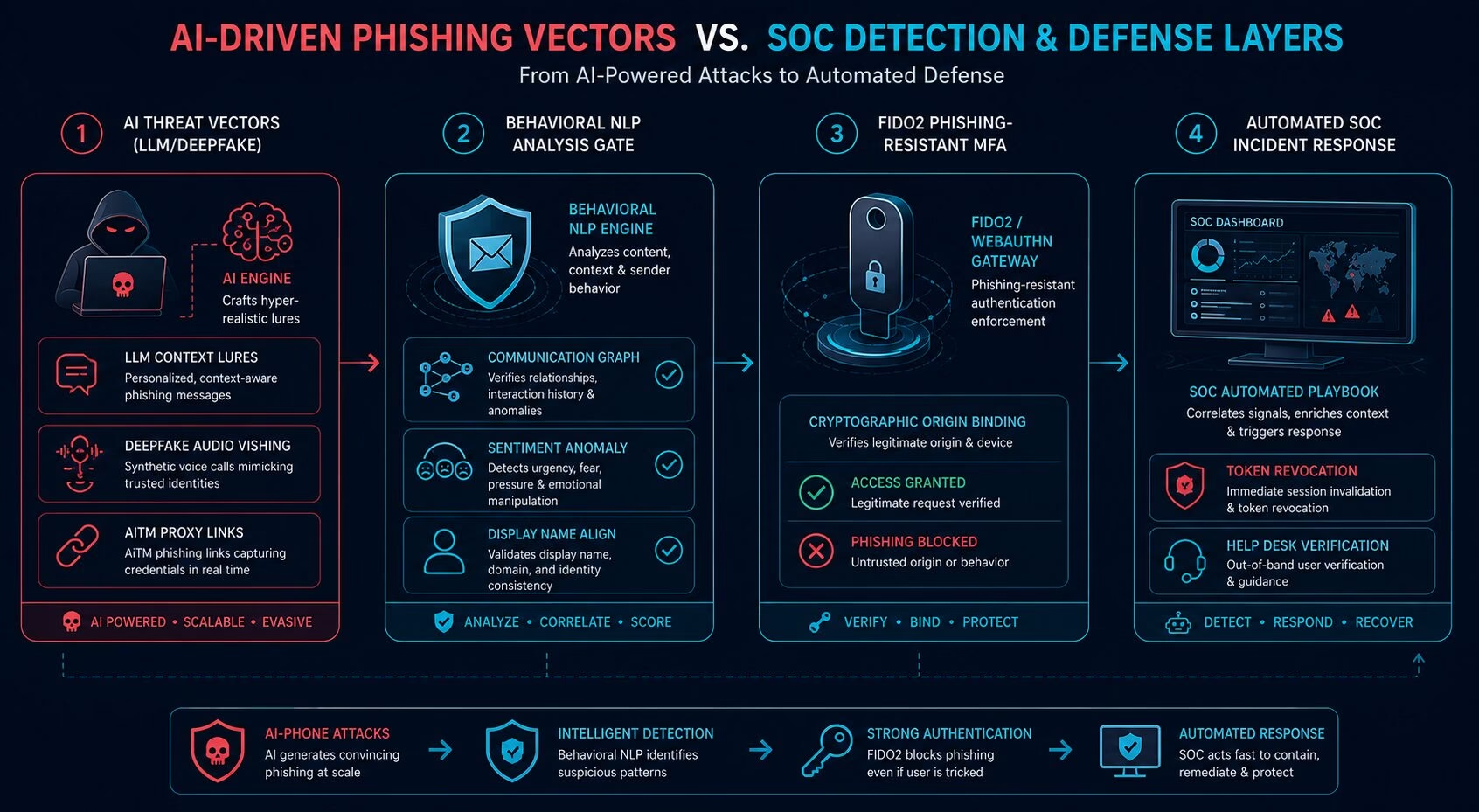
Generative AI enables attackers to remove friction from every phase of the social engineering lifecycle:
- Hyper-Personalized Reconnaissance: Attackers scrape public executive profiles, LinkedIn activity, corporate press releases, and compromised email archives. LLMs synthesize these inputs to craft personalized lures tailored to specific roles, ongoing projects, or vendor relationships.
- Grammar & Tone Spoofing: LLMs generate grammatically flawless messages matching the exact communication cadence, tone, and signature style of trusted executives or external vendors.
- Deepfake Audio & Video Vishing: Attackers clone executive voices using audio samples extracted from public webcasts or social media. These deepfake audio files are used in multi-channel social engineering operations over phone calls or messaging apps to authorize urgent wire transfers or MFA resets.
The Failure of Traditional Email Security Gateways
Legacy Secure Email Gateways (SEGs) rely heavily on static IP reputation, domain age, known malicious URL blocklists, and signature-based attachment scanning. AI-generated phishing messages bypass these legacy controls because:
- They contain no malicious links or malware attachments (relying instead on pure text payload/BEC).
- They use newly registered or compromised high-reputation domains with valid SPF, DKIM, and DMARC alignment.
- They vary language structure dynamically across thousands of targets, rendering static pattern-matching rules ineffective.
How SOCs Detect & Block AI-Driven Threats
Modern SOC teams deploy a multi-layered defense model combining Natural Language Processing (NLP), behavioral analytics, and protocol-level identity controls.
                       Incoming Email / Message
                                  |
                                  v
+------------------------------------------------------------------+
|               BEHAVIORAL EMAIL SECURITY (NLP & ML)                |
|  - Baseline Communication Graph Analysis                         |
|  - Sentiment & Urgency Anomaly Detection                         |
|  - Display Name & Vendor Domain Parsing                          |
+---------------------------------+--------------------------------+
                                  |
                      Pass / Flag for SOC Triage
                                  |
+---------------------------------v--------------------------------+
|                 PHISHING-RESISTANT AUTHENTICATION                 |
|  - FIDO2 / WebAuthn Hardware Security Keys                       |
|  - Cryptographic Domain Binding (Eliminates Reverse Proxies)     |
+------------------------------------------------------------------+
1. Behavioral Science & NLP Email Inspection
Cloud-native Integrated Cloud Email Security (ICES) platforms analyze communication graphs rather than relying solely on headers. These systems establish a baseline of normal interactions (who communicates with whom, typical response times, writing style, and device context).
When an incoming email departs from established baselines (such as an executive asking for an urgent gift card purchase or wire transfer change), the NLP engine flags the message with contextual banners or quarantine workflows.
2. Phishing-Resistant MFA (FIDO2 / WebAuthn)
Adversary-in-the-Middle (AiTM) phishing kits (such as Evilginx) bypass traditional push-notification or SMS-based Multi-Factor Authentication by proxying credentials and session tokens in real time.
To counteract AiTM attacks and AI-driven credential harvesting, CISA guidance strongly emphasizes migrating to FIDO2 / WebAuthn phishing-resistant authentication. FIDO2 binds the authentication ceremony cryptographically to the specific origin URL in the browser bar, rendering intercepted credentials and session tokens useless on attacker-controlled phishing domains.
3. Hardening the Account Recovery & Help Desk Vector
As primary authentication ceremonies shift to hardware passkeys, attackers shift pressure to account recovery pathways. Guidance from threat intelligence reports highlights that threat actors frequently impersonate employees over voice or IT support chat to request MFA resets or temporary access passes.
SOCs must harden help desk workflows by enforcing out-of-band verification, manager sign-offs, and mandatory two-person authorization before resetting authenticators for privileged roles.
SOC Incident Response Checklist
When investigating suspected AI-driven social engineering incidents, SOC analysts should follow this 4-step triage workflow:
- Inspect Envelope vs. Header Alignment: Analyze raw email headers for DKIM replay attacks or subtle display-name spoofing.
- Review Identity & Session Telemetry: Check SIEM and IdP logs for concurrent sign-in anomalies, unfamiliar user agents, or rapid OAuth grant approvals.
- Revoke Active Tokens: If a session token compromise is suspected, immediately terminate active user sessions and revoke refresh tokens across cloud identity providers.
- Feed Detections Back into Detection Engineering: Update behavioral detection rules and share IOCs/patterns across the threat intelligence pipeline.
Key Takeaways
- Generative AI allows threat actors to scale hyper-personalized, error-free BEC and phishing campaigns without relying on malware.
- Legacy SEGs miss pure-text BEC attacks; detection requires behavioral NLP platforms that analyze communication graphs.
- Implementing FIDO2/WebAuthn phishing-resistant MFA is the most effective protocol-level defense against AiTM credential harvesting.