
Table of Contents
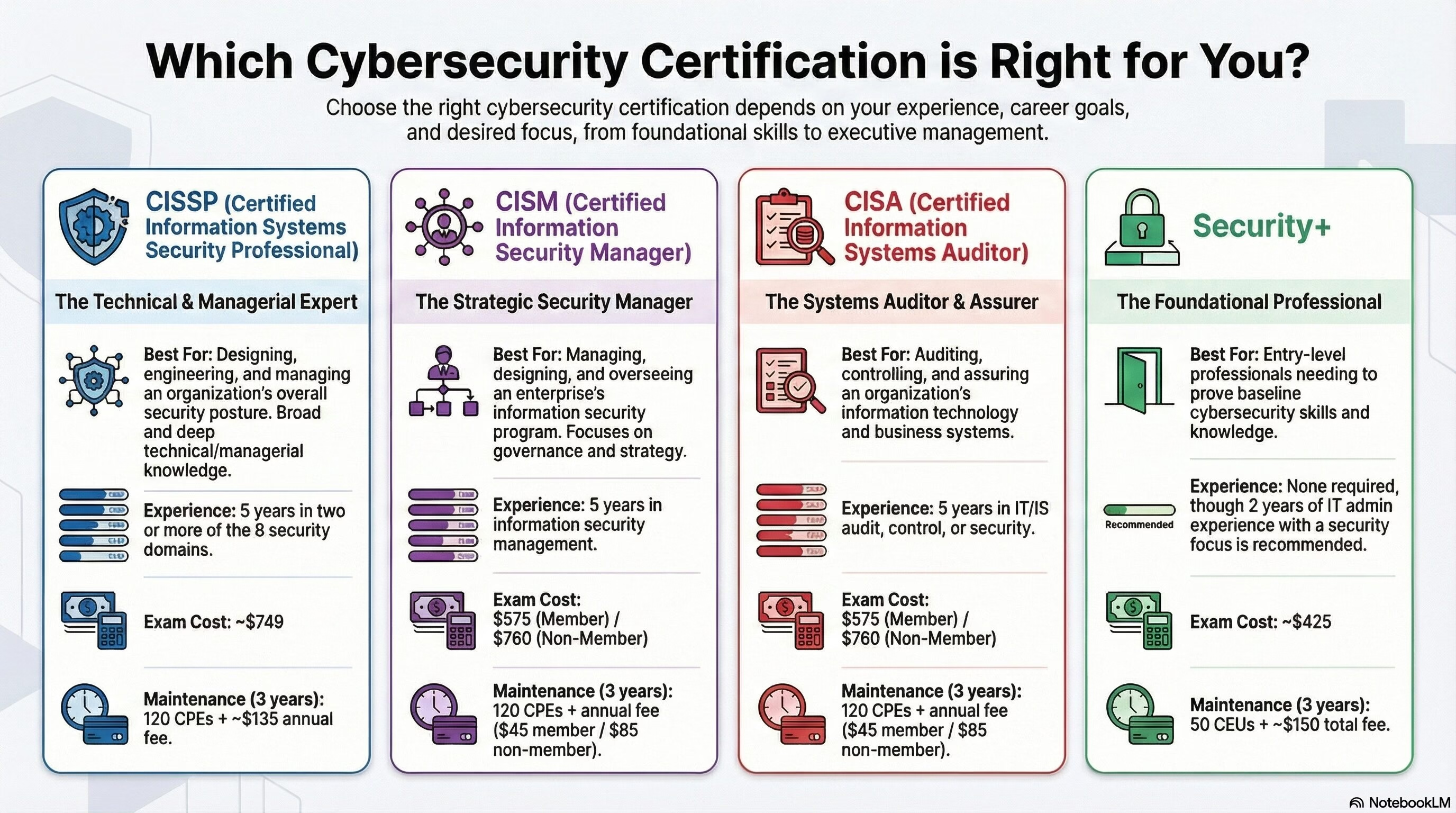
Here is a detailed comparison of the four major cybersecurity certifications—CISSP, CISM, CISA, and Security+—designed to help you decide which path fits your career goals.
Quick Comparison Table
| Feature | Security+ (CompTIA) | CISSP (ISC2) | CISM (ISACA) | CISA (ISACA) |
|---|---|---|---|---|
| Best For… | Beginners & Career Switchers Starting a career in cyber security. | Security Architects & Engineers Designing and building secure systems. | Managers & Directors Overseeing security strategy and governance. | Auditors & Compliance Pros Verifying that systems and controls work. |
| Experience Needed | None (though 2 years of IT experience is recommended). | 5 Years in security (Waivers available for 1 year). | 5 Years total, with 3 years specifically in security management. | 5 Years in auditing, control, or security (Waivers available up to 3 years). |
| Primary Focus | Operational security, troubleshooting, and core technical skills. | Security architecture, engineering, and deep technical understanding across 8 domains. | Management, risk management, and aligning security with business goals. | Auditing, assurance, control, and validating system integrity. |
| Exam Cost (US) | ~$425. | $749. | $575 (Member) / $760 (Non-member). | $575 (Member) / $760 (Non-member). |
| Difficulty | Entry-Level/Intermediate Foundational knowledge. | Advanced/Difficult “A mile wide and an inch deep”. | Advanced Requires a management mindset. | Advanced Requires an auditor mindset. |
| Avg. Salary (US) | $60k – $100k+ Entry to Mid-level roles. | $120k – $173k+ Senior roles. | $120k – $175k+ Management roles. | $75k – $150k+ Audit/Assurance roles. |
| Maintenance | $150 every 3 years (or $50/year). | $135 per year. | $45 – $85 per year. | $45 – $85 per year. |
In-Depth Breakdown
1. CompTIA Security+ (The Foundation)
Think of Security+ as the “gateway” to the cybersecurity industry. It is the most accessible of the four because it does not require you to have years of job experience before you take the exam.
- What it covers: It validates that you know the core “survival skills” of the industry: how to identify threats, basic risk management, and how to configure secure networks and devices.
- Who should take it: If you are in a help desk role, a junior administrator, or completely new to the field, this is your starting line. It proves you have the baseline skills necessary for entry-level roles.
2. CISSP (The Architect)
The CISSP is often called the “gold standard” for a reason. It is designed for the builders and the architects of the security world. It covers a massive range of topics—from physical security (like fences and locks) to software development security.
- What it covers: It is technically rigorous. You must demonstrate that you can design and engineer a complete security program for an organization.
- The “Manager” vs. “Doer” distinction: While the CISSP covers management concepts, it is heavily focused on the design and implementation of technical safeguards. It effectively says, “I know how to build a secure fortress”.
- The Hurdle: You cannot just pass the test; you must prove you have done the work for at least five years.
3. CISM (The Manager)
If the CISSP is for the person designing the fortress, the CISM is for the person managing the budget, the strategy, and the team guarding it. It requires you to stop thinking like a technician (“How do I configure this firewall?”) and start thinking like a business leader (“Does this firewall investment align with our profit goals?”).
- What it covers: Governance, risk management, and incident response. It focuses heavily on how security fits into the broader business strategy.
- The Experience Catch: You need five years of experience, but critically, three of those years must be in management. This makes it strictly a credential for experienced leaders, not those trying to break into their first management role.
4. CISA (The Auditor)
The CISA is the standard for the “checkers.” While the other certifications focus on building or managing security, the CISA focuses on assurance—proving that the systems actually work the way they are supposed to.
- What it covers: The audit process, governance, and protecting information assets. It validates that you can objectively assess an organization’s computer systems and report on compliance.
- Career Path: This is highly valued in banking, finance, and government sectors where regulations (like GDPR or SOX) are strict. If you enjoy investigation and compliance, this is the path for you.
Which One Should You Choose?
- Choose Security+ if: You are just starting out, have less than 5 years of experience, or want to move from general IT into a dedicated security role.
- Choose CISSP if: You are a senior engineer or architect who wants to prove you have deep technical knowledge across all domains of security. It is ideal if you want to be a “doer” at a senior level or a CISO.
- Choose CISM if: You are ready to move away from the keyboard and into the boardroom. This is the best choice if you want to be a Security Manager or Director and focus on strategy rather than configuration.
- Choose CISA if: You want to work in audit, compliance, or assurance. It is the specific credential for those who need to verify that an organization’s data is accurate, reliable, and secure.
The “Stacking” Strategy: Many professionals do not stop at one. A common and powerful career strategy is to start with Security+, move to CISSP to prove technical mastery, and later add CISM when transitioning into executive leadership. Alternatively, holding both CISSP (Security) and CISA (Audit) creates a powerful combination of skills, allowing you to both build secure systems and validate them—a concept often called “The Full Monty” of certification.


